
SG HEALTHCARE AI
DATATHON & EXPO
Results for the Datathon
Datasets
Reminder: Teams need to apply and obtain access to the datasets they intend to use before the datathon.
1. Electrical Medical Records Datasets
During the datathon, teams will have access to 3 de-identified EMR datasets. Teams may choose to use one or all of these datasets to answer their clinical questions. In particular, these three datasets are: 1) the Medical Information Mart for Intensive Care (MIMIC)-IV Database from Physionet 2) the Philips eICU Collaborative Research Database (https://eicu-crd.mit.edu/). These three databases share similar data schemas. They contain hourly physiologic readings from bedside monitors, validated by ICU nurses. They also contain records of demographics, labs, nursing progress notes, discharge summaries, IV medications, fluid balance, and other clinical variables.
MIMIC-IV Dataset
Introduction & Access Application: https://mimic-iv.mit.edu/
Github repository: https://github.com/MIT-LCP/mimic-iv
Documentation: https://mimic-iv.mit.edu/docs/
When using this resource, please cite:
Johnson, A., Bulgarelli, L., Pollard, T., Horng, S., Celi, L. A., & Mark, R. (2020). MIMIC-IV (version 0.4). PhysioNet. https://doi.org/10.13026/a3wn-hq05.
Goldberger, A., Amaral, L., Glass, L., Hausdorff, J., Ivanov, P. C., Mark, R., ... & Stanley, H. E. (2000). PhysioBank, PhysioToolkit, and PhysioNet: Components of a new research resource for complex physiologic signals. Circulation [Online]. 101 (23), pp. e215–e220.eICU-CRD Dataset
Introduction & Documentation: https://eicu-crd.mit.edu/about/eicu/
Github repository: https://github.com/mit-eicu/eicu-code
Example code: https://github.com/mit-eicu/eicu-code/blob/master/concepts/icustay_detail.sql
When using this resource, please cite:
Pollard, T., Johnson, A., Raffa, J., Celi, L. A., Badawi, O., & Mark, R. (2019). eICU Collaborative Research Database (version 2.0). PhysioNet. https://doi.org/10.13026/C2WM1R.Goldberger, A., Amaral, L., Glass, L., Hausdorff, J., Ivanov, P. C., Mark, R., ... & Stanley, H. E. (2000). PhysioBank, PhysioToolkit, and PhysioNet: Components of a new research resource for complex physiologic signals. Circulation [Online]. 101 (23), pp. e215–e220.
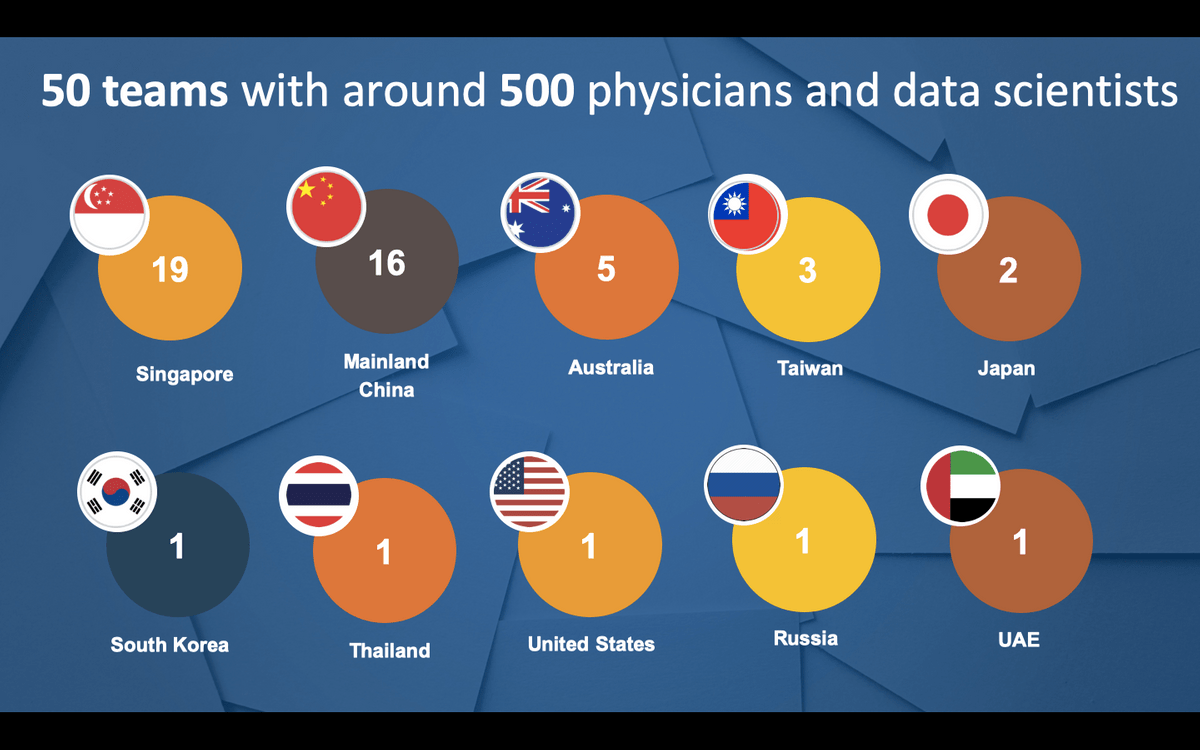
We had 50 teams with close to 500 physicians and data scientists from more than 10 regions that joined us in our 2020 event!

- And the winner goes to...
Champion
Team 36: Developing an algorithm to predict real-time hourly variation of ICP
First Runner-up
Team 11: Drug-drug Interactions via Graph Neural network and Causal Inference
First Runner-up
Team 15: Diagnosis and Prediction of Diabetes via Overnight SpO2 Signal Based on Deep Learning
Second Runner-up
Team 09: AI model for Intraoperative Hypoxemia Prediction
Second Runner-up
Team 50: Early Prediction of Sepsis Mortality using Multimodal Machine Learning
Second Runner-up
Team 55: Using Explainable AI for Image Analysis in Diabetic Foot Ulcers
Best Presentation Award
Team 21: Application of Three-stage Prediction of Mortality in Critically Ill Patients
Best Presentation Award
Team 28: Heterogeneity in Treatment Effects of Hydrocrotisone for Sepsis
Best Potential Award
Team 54: Paediatric Pneumonia Chest C-ray Classification
Best Potential Award
Team 59: Blindness Terminator
SINGAPORE HEALTHCARE AI DATATHON AND EXPO 2021